
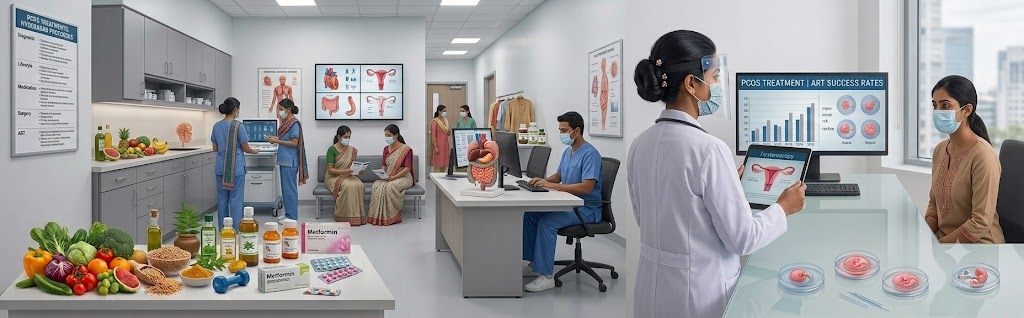
Comparing PCOS Treatment Options: Lifestyle Changes, Medications, Surgery and Assisted Reproduction
PCOS is one of those diagnoses that arrives with more questions than answers. You’ve likely heard it affects periods, weight, skin, and fertility all at once — and then, often in the same appointment, you’re handed a treatment plan without much explanation of why that particular approach, or what the alternatives might have looked like. If you’ve felt like you’re managing PCOS rather than actually understanding it, this is meant to fill that gap.
Why PCOS Doesn't Have One Standard Treatment
Polycystic ovary syndrome isn’t a single condition with a single fix — it’s a hormonal pattern that shows up differently from person to person. Some women’s main concern is irregular or absent periods. Others are focused on visible symptoms like acne or excess hair growth. Others come in specifically because PCOS is affecting their ability to conceive. Treatment is built around which of these is the priority, not a fixed protocol applied the same way to everyone.
Lifestyle Changes: Often the First Step, Rarely the Whole Answer
Weight management, when relevant, genuinely does improve hormonal balance for many women with PCOS — even a modest reduction in body weight can restore more regular ovulation for some patients. Dietary patterns that manage insulin resistance (since PCOS is closely linked to how the body processes insulin) and regular physical activity are usually recommended as a foundation, regardless of what other treatment follows.
Where this gets frustrating is when lifestyle advice is offered as the entire plan, particularly for women actively trying to conceive and working against a timeline. Lifestyle changes are worth pursuing, but they’re rarely sufficient on their own when fertility is the goal.
Medications: Different Drugs for Different Goals
This is where treatment plans diverge the most, based on what you’re actually trying to address.
For irregular cycles or endometrial protection, hormonal birth control or progesterone therapy is often used — not to treat PCOS itself, but to manage the downstream effects of infrequent ovulation.
For insulin resistance, medications like metformin are commonly prescribed, sometimes alongside lifestyle changes, particularly when blood sugar regulation is part of the picture.
For ovulation induction, when pregnancy is the goal, medications like letrozole or clomiphene are typically first-line, used to encourage regular ovulation directly.
For symptom management — acne, excess hair growth — anti-androgen medications may be added, chosen based on which symptoms are most bothersome to you specifically.
None of these are interchangeable, which is why “PCOS medication” as a general phrase doesn’t mean much without knowing what a specific medication is targeting.
Surgery: A Less Common, but Real, Option
Ovarian drilling — a minimally invasive laparoscopic procedure — is occasionally used for women who haven’t responded to ovulation induction medication, working by reducing androgen-producing tissue in the ovary to help restore ovulation. It’s not a first-line treatment, and most patients won’t need it, but it remains a legitimate option when medication alone hasn’t worked.
Assisted Reproduction: When the Goal Is Specifically Pregnancy
For women with PCOS trying to conceive, if oral ovulation induction medications don’t lead to pregnancy after a reasonable number of cycles, the next step is often IUI (intrauterine insemination) timed with ovulation induction, and if that doesn’t succeed, IVF. Women with PCOS often respond very well to ovarian stimulation for IVF — sometimes producing a higher number of eggs than average — though this also means stimulation protocols need careful monitoring to avoid overstimulation, which is a real and well-managed risk specific to PCOS patients.
Building a Plan Around Your Actual Priority
The most useful question to ask at a PCOS consultation isn’t “what’s the treatment” — it’s “given that my main concern is X, what’s the right sequence of options for me?” Whether X is regular periods, skin and hair symptoms, or pregnancy changes the entire plan, and a good specialist will ask this before recommending anything.
At IVY Women and Fertility Centre, PCOS consultations start with exactly this conversation — understanding your specific priority before building a treatment sequence — across both the Gachibowli and Kondapur locations. For many patients, particularly those who’ve previously been given a single blanket recommendation elsewhere, this priority-first approach is what finally makes the plan feel like it’s actually for them.
Frequently Asked Questions
PCOS is a chronic hormonal condition rather than something that’s cured, but its symptoms — irregular cycles, fertility challenges, skin and hair changes — can be effectively managed with the right combination of treatments.
Not necessarily. Many women with PCOS conceive with lifestyle changes and ovulation induction medication alone. Fertility treatment like IUI or IVF becomes relevant if those steps don’t lead to pregnancy after a reasonable trial period.
Weight management can improve symptoms for many women with PCOS, but it’s not a universal requirement — treatment plans can and do work for women at any body weight, tailored to their specific hormonal picture.
Women with PCOS often have a higher number of follicles that respond to stimulation medication, which increases the risk of ovarian hyperstimulation syndrome (OHSS). Careful monitoring and adjusted protocols significantly reduce this risk.