
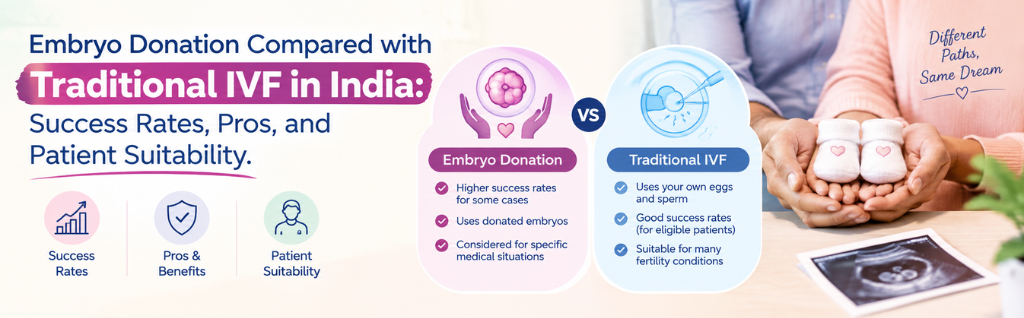
Embryo Donation Compared with Traditional IVF in India: Success Rates, Pros, and Patient Suitability
For couples who’ve been through several rounds of IVF without success, or who’ve received a diagnosis that makes using their own eggs and sperm unlikely to work, embryo donation is often the option that gets mentioned last — sometimes almost as an afterthought — even though for the right patient, it can be the option with the clearest path forward.
If it’s come up in a conversation with your specialist, or you’ve found yourself researching it late at night, it’s worth understanding clearly: what it actually involves, how the odds compare to a traditional IVF cycle, and who it tends to be right for.
What Embryo Donation Actually Involves
Embryo donation uses embryos created by another couple or through donor egg and sperm, which are then transferred into the recipient’s uterus. Unlike egg or sperm donation alone, both genetic contributions come from the donors — the recipient carries the pregnancy but isn’t genetically related to the child.
This is a meaningfully different starting point from traditional IVF, where at least one, and often both, genetic contributions come from the intending parents. It’s worth sitting with that difference before moving further, since it’s as much an emotional decision as a medical one.
How the Numbers Compare
This is where embryo donation often surprises people, in a good way. Because donated embryos typically come from younger donors with good egg and sperm quality, and are often pre-screened for quality before donation, success rates per transfer can be comparable to — and in some cases higher than — a traditional IVF cycle using a patient’s own eggs, particularly for women in their late 30s or early 40s.
That said, “comparable success rate” doesn’t mean “guaranteed,” and outcomes still depend on:
- The recipient’s uterine health and endometrial receptivity
- The quality grading of the specific embryo being transferred
- Whether the transfer is a single embryo or, in select cases, more than one
- General health factors that affect implantation, independent of the embryo itself
A good specialist will walk through your own uterine assessment before giving you a number specific to your situation, rather than quoting a blanket embryo donation success rate.
Who Tends to Be a Good Candidate
Embryo donation isn’t the right next step for everyone, but it tends to be worth a serious conversation for:
- Couples who’ve had multiple unsuccessful IVF cycles despite good protocol adjustments
- Women with very low or no ovarian reserve, where egg donation alone might still be considered, but embryo donation offers a potentially faster or more cost-effective path
- Couples facing both male and female factor infertility simultaneously
- Patients who’ve been advised against using their own eggs due to a significant genetic condition
- Single intending parents or same-sex couples exploring donor-assisted routes
It’s also worth saying plainly: choosing embryo donation isn’t a failure of anything. For many patients, it’s simply the option that gives the clearest, most realistic path to carrying a pregnancy.
The Emotional Side, Which Is Real
Most of the medical literature on embryo donation focuses on success rates and protocols, and understandably so — but the decision carries real emotional weight that’s worth naming rather than skipping past. Questions about genetic connection, how (or whether) to discuss it with a future child, and grief over not using one’s own genetic material are all normal parts of this decision. Many clinics, IVY included, build counselling into the process specifically because these questions deserve space, not just a consent form.
What This Looks Like in Practice
At IVY Women and Fertility Centre, embryo donation conversations start with a full review of prior treatment history and a fresh uterine assessment — because the recipient’s own health picture matters just as much as the embryo itself. The clinic sees this conversation happen at both its Gachibowli and Kondapur locations, and increasingly with patients coming in from further out — Patancheru, BHEL, Chandanagar, Hafeezpet, Miyapur — who’ve often been through years of treatment elsewhere before finding a clinic close enough to have this kind of unhurried conversation properly.
If embryo donation has come up for you, the most useful next step isn’t reading more comparisons online — it’s a direct conversation with a specialist who can look at your specific history and tell you, honestly, whether it’s a strong option for you.
Frequently Asked Questions
No. Embryo donation is a medical procedure where a donated embryo is transferred into the recipient’s uterus, and the recipient carries and gives birth to the child. It’s legally and procedurally distinct from adoption, though some of the emotional considerations overlap.
Most clinics screen for infectious diseases and genetic conditions, and grade embryo quality before making them available for donation. It’s reasonable to ask a clinic directly what their specific screening protocol includes.
In some cases, donated embryos have already undergone preimplantation genetic testing before donation. This isn’t universal, so it’s worth asking specifically if PGT status matters to you.
Embryo donation is regulated in India under the Assisted Reproductive Technology (Regulation) Act, and clinics must follow specific consent, screening, and documentation requirements. A licensed clinic will be able to walk you through exactly what’s required.