
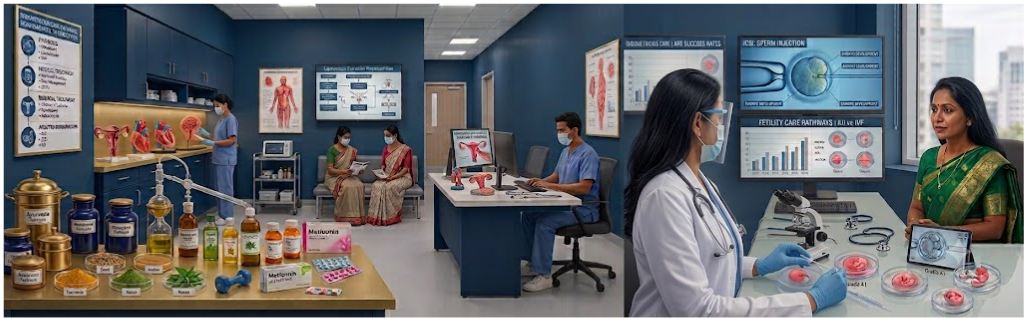
From Diagnosis to Conception: Medical, Surgical and Assisted Reproduction Options for Endometriosis
Endometriosis has a frustrating reputation for taking years to diagnose — many women live with painful periods for a long time before anyone connects the dots. If you’ve recently been diagnosed, or you’re trying to conceive and endometriosis has come up as a possible factor, you’re likely past the “what is this” stage and into a much more specific question: what actually happens next, especially if pregnancy is the goal.
What Endometriosis Does to Fertility, Specifically
Endometriosis occurs when tissue similar to the uterine lining grows outside the uterus — often on the ovaries, fallopian tubes, or pelvic lining — and it can affect fertility in a few distinct ways: physical scarring or adhesions that block or distort the fallopian tubes, inflammation that affects egg quality or embryo implantation, and in some cases, ovarian cysts (endometriomas) that reduce ovarian reserve. Not every case affects fertility to the same degree, which is part of why treatment is so individualised.
Medical Management: Managing Symptoms, Not Necessarily Fertility
Hormonal treatments — birth control, progestin therapy, GnRH agonists — are commonly used to manage endometriosis pain and slow tissue growth. It’s important to understand what these medications are and aren’t doing: they manage symptoms and can slow progression, but most hormonal treatments also suppress ovulation, which means they’re not compatible with actively trying to conceive. This is a common point of confusion — a treatment that helps with pain may need to be paused specifically when pregnancy becomes the goal.
Surgical Treatment: Often the Bridge Between Symptom Management and Trying to Conceive
Laparoscopic surgery to remove or reduce endometrial tissue and adhesions is frequently recommended for women with endometriosis who are trying to conceive, particularly when there’s evidence of blocked tubes, significant scarring, or endometriomas affecting the ovaries. For many women, surgery improves natural conception chances directly by clearing physical obstacles to pregnancy.
That said, surgery isn’t automatically the first step for everyone. The decision depends on severity, location of the endometrial tissue, age, and how long you’ve been trying to conceive — which is why an accurate diagnosis, usually combining ultrasound findings with your symptom history, matters before deciding whether surgery makes sense for you specifically.
When Natural Conception Isn't Working: IUI and IVF
For mild endometriosis without significant tubal blockage, IUI (intrauterine insemination) is sometimes tried first, particularly for younger patients with a reasonable ovarian reserve. For moderate to severe endometriosis, especially where the fallopian tubes are affected or ovarian reserve is reduced, IVF is often recommended more directly, since it bypasses the tubes entirely and allows for more controlled monitoring of egg quality and embryo development.
Women with endometriosis, particularly involving endometriomas, may also see a somewhat different response to ovarian stimulation than women without the condition — which is why fertility specialists often adjust protocols based specifically on endometriosis severity, rather than using a standard stimulation approach.
The Question of Timing Surgery and IVF Together
One of the more nuanced decisions in endometriosis-related fertility treatment is whether to do surgery before IVF, or move straight to IVF without surgery first. Surgery can improve natural conception chances and may improve IVF outcomes in certain cases, but repeated or extensive ovarian surgery can also reduce ovarian reserve — which matters enormously for women who may already have reduced reserve due to endometriomas. This is a genuinely individual decision, made based on age, ovarian reserve testing, and the specific findings from imaging, not a default sequence applied to everyone.
Building a Realistic Plan
If there’s one theme running through all of this, it’s that endometriosis treatment for fertility isn’t a fixed sequence — it’s a series of decisions that depend on your specific severity, age, and ovarian reserve, made in conversation with a specialist who’s looking at your actual scans and history.
At IVY Women and Fertility Centre, this decision-making process — weighing medical management, surgical options, and assisted reproduction against your specific diagnosis and fertility goals — happens with input from both fertility specialists and surgical expertise under one roof, across the Gachibowli and Kondapur locations. For patients who’ve spent years getting a diagnosis, having that full conversation in one place, rather than being sent between separate providers, tends to make the next steps feel far less fragmented.
Frequently Asked Questions
Yes, many women with mild to moderate endometriosis conceive naturally, sometimes with surgical treatment first to improve the odds. Severity and specific findings on imaging are the main factors that determine how likely natural conception is.
No. Surgery is recommended based on specific findings — like blocked tubes or endometriomas — not for every case. Some patients move directly to IUI or IVF without surgery, depending on severity and other fertility factors.
In some cases, particularly with endometriomas or more severe disease, ovarian reserve and egg quality can be affected. This is one reason ovarian reserve testing is an important part of the diagnostic workup.
This varies by the extent of surgery and individual recovery, but many specialists suggest a window of a few months post-surgery before actively trying, or before starting IVF, to allow proper healing.